

Health & Wellness
The Best At-Home Microdermabrasion Devices: 4 Compared (and One to Skip)
We compared four at-home resurfacing devices on abrasive type, how many grits and tips come in the box, speed settings, battery and warranty, and which of them is actually microdermabrasion.
The short version
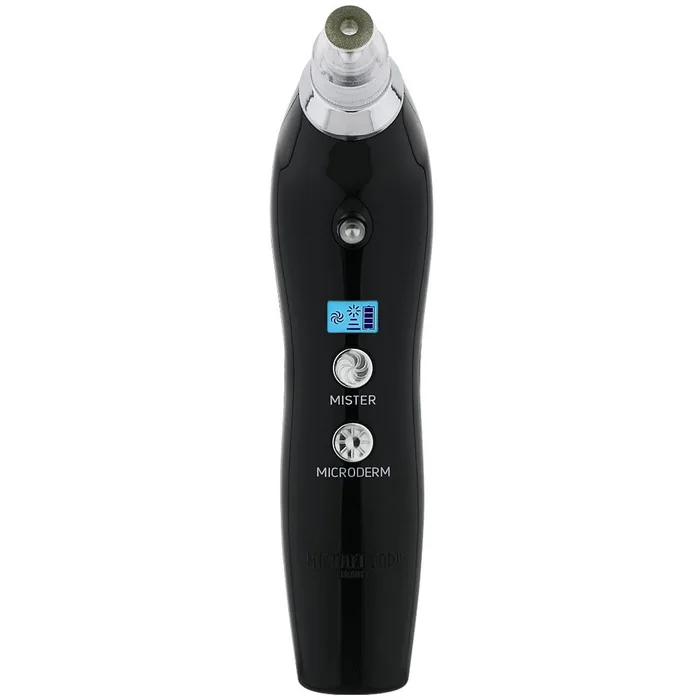
The Michael Todd Sonic Refresher is the one to buy: a wet and dry sonic microdermabrasion system that ships with three diamond heads at different grits, coarse, fine and small fine, plus three pore extraction heads, a hydrating micromist step, a wireless charging cradle and a 3-year warranty, which is three times what anyone else here offers. The Spa Sciences MIO is the value pick, with a diamond rejuvenation tip, three suction extraction tips, five speed settings, a 60 minute battery that is lithium-free and therefore travel-legal, twenty single-use filters in the box and a published expectation of significant results after eight to twelve weeks of weekly treatments. The PMD Personal Microderm Pro uses a spinning disc with a vacuum instead of a diamond tip, with disc grades from sensitive to very coarse and extra speeds, though PMD publishes no warranty, battery or session guidance. The DERMAFLASH DERMAPORE+ is the one to skip if microdermabrasion is what you came for, because it is an ultrasonic spatula with ionic infusion and does not abrade the skin at all. Best for: anyone considering monthly clinic facials who wants to do the exfoliating part at home.
Our picks at a glance
- Michael Todd Beauty Sonic Refresher - Buy. Three diamond grits, three extraction heads, a wet mode and a three-year warranty.
- Spa Sciences MIO Diamond Microdermabrasion System - Buy. Five speeds, a travel-legal battery and the clearest statement of what to expect and when.
- PMD Beauty Personal Microderm Pro - It depends. A spinning crystal disc rather than a diamond tip, with the widest grit range and the thinnest documentation.
- DERMAFLASH DERMAPORE+ - Skip. A good ultrasonic pore extractor, and not microdermabrasion in any sense.
The verdict in 30 seconds
What mattered most
- Abrasive type
- Grits or grades included
- Extraction tips
- Speed settings
- Wet use
- Battery
Microdermabrasion works by two things happening at once: an abrasive surface takes off the outermost layer of dead skin, and a vacuum lifts the debris away and pulls blood to the surface. Take away either half and you have something else. That matters because the shelf labelled at-home microdermabrasion now contains diamond-tip devices, spinning crystal discs, sonic wet-and-dry systems and ultrasonic spatulas that do not abrade at all, all sold on the same promise of smoother skin. We compared three genuine microdermabrasion devices and one that is frequently bought as one, and the specifications that separate them are simple: how many grits you get, how many speeds, and how long the maker will stand behind it.
Three diamond grits, three extraction heads, a wet mode and a three-year warranty.
Best for: Someone who wants one device to exfoliate, extract and hydrate, with grit options for different areas.
- Three microdermabrasion heads at different grades, a coarse diamond head, a fine diamond head and a small fine head for delicate areas, plus three pore extraction heads.
- Wet and dry sonic operation with a hydrating micromist step, so exfoliation, extraction and rehydration happen in one routine rather than three devices.
- A 3-year warranty, three times the cover on the MIO, with a wireless charging cradle and a USB cable in the box.
- Michael Todd publishes no speed count, no battery runtime, no weight and no dimensions.
- The world's first and patented claims appear with no patent number or date on the page.
- It is the most expensive device in this comparison.
- No treatment frequency or expected timeline is published, so you are left to judge for yourself.
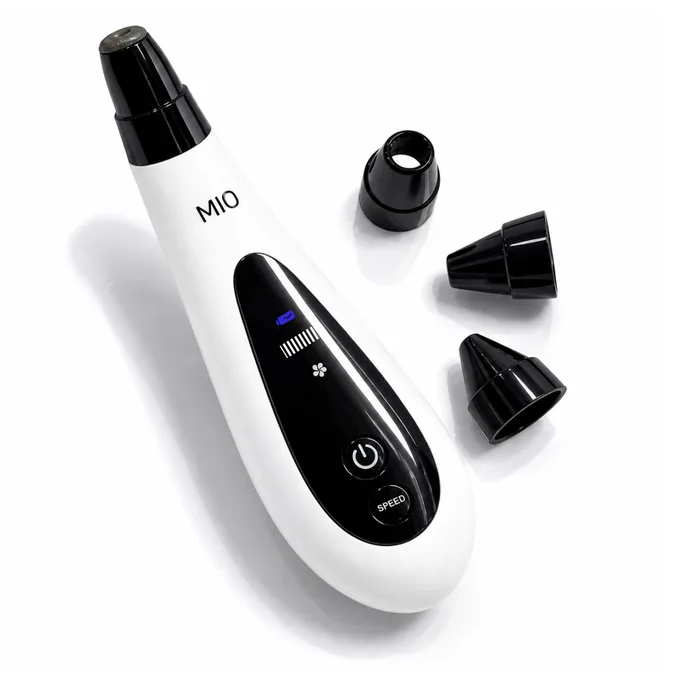
Five speeds, a travel-legal battery and the clearest statement of what to expect and when.
Best for: A first microdermabrasion device, and anyone who travels and wants to take it along.
- A laser-cut diamond rejuvenation tip plus three suction extraction tips in different shapes and sizes, with five speed settings to match the level of exfoliation to your skin.
- A USB rechargeable NiMH battery that is lithium-free and therefore permitted in carry-on or checked baggage, with a 60 minute maximum runtime and cord-free operation.
- Spa Sciences publishes what to expect: softer skin after the first session, and significant improvement in fine lines, hydration, pore size and tone after eight to twelve weeks of weekly treatments, along with twenty single-use filters, full cleaning instructions and a 1-year limited warranty.
- One diamond grit only, where the Sonic Refresher ships with three.
- A 1-year limited warranty, the shortest of the three microdermabrasion devices here.
- Spa Sciences warns that using anything other than a 5V 1A or 5V 2A charger can cause the unit to overheat, which is an unusual thing to have to remember.
- The foam filters are consumables and twenty of them will not last long at weekly use.
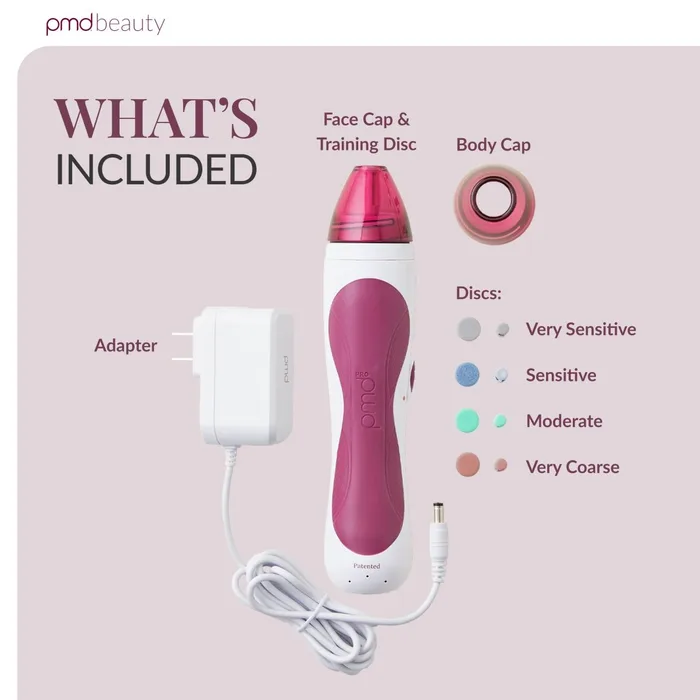
A spinning crystal disc rather than a diamond tip, with the widest grit range and the thinnest documentation.
Best for: Body use and thicker skin, where a very coarse disc does what a fine diamond tip cannot.
- A spinning disc and vacuum system with four disc grades, very sensitive, sensitive, moderate and very coarse, which is a wider abrasive range than any diamond tip here.
- Additional speed and disc options over the Classic, so treatments can be dialled from sensitive to intense.
- The box holds a face cap with a training disc, a body cap, the four disc grades and a mains adapter, so both face and body use are covered out of the box.
- PMD publishes no warranty terms, no battery life, no weight, no dimensions and no treatment frequency on the product page.
- The discs are consumables sold separately, so the running cost is higher than a diamond tip you simply wash.
- The claim that it enhances skincare absorption by 20 times appears with no supporting study cited.
- A spinning disc is less forgiving than a diamond tip on curved areas and around the nose.
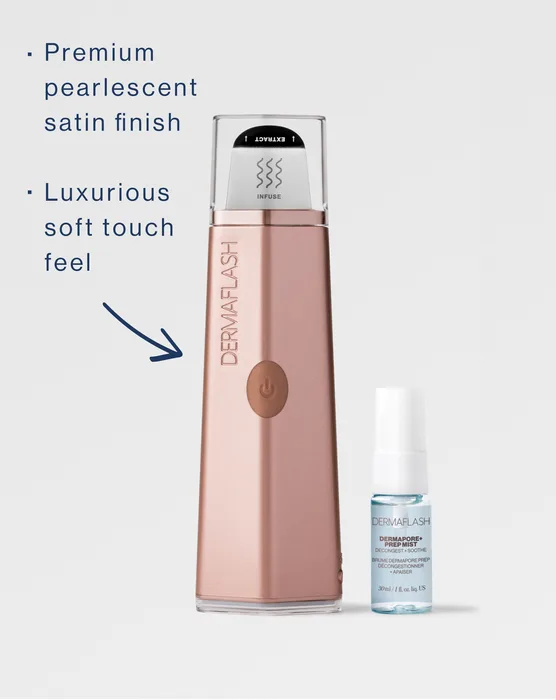
A good ultrasonic pore extractor, and not microdermabrasion in any sense.
Best for: Blackheads and congestion, as a companion to a separate exfoliating device rather than a replacement.
- Ultrasonic extraction with ionic infusion, which pushes skincare in after clearing the pore rather than only taking debris out.
- DERMAFLASH says it is clinically proven to visibly reduce pore size, and it is described as suitable for all ages and skin types including sensitive skin.
- The box includes the device, a 0.5 fl oz Prep Mist and a USB charging cable, so nothing else is needed to start.
- It has no abrasive surface, no diamond tip, no crystals and no vacuum, so it does not resurface skin the way microdermabrasion does.
- No warranty terms, battery runtime or speed count are published on the product page.
- The Prep Mist is a consumable and DERMAFLASH sells it on subscription.
- Buying it expecting the smoothing effect of microdermabrasion will disappoint, because that is not what it is for.
| Criteria | Sonic Refresher Top pick | MIO Diamond Microdermabrasion System | Personal Microderm Pro | DERMAPORE+ |
|---|---|---|---|---|
| Verdict | Buy it | Buy it | It depends | Skip it |
| Best for | Someone who wants one device to exfoliate, extract and hydrate, with grit options for different areas. | A first microdermabrasion device, and anyone who travels and wants to take it along. | Body use and thicker skin, where a very coarse disc does what a fine diamond tip cannot. | Blackheads and congestion, as a companion to a separate exfoliating device rather than a replacement. |
| Price tier | $$$ · premium | $ · budget | $$ · mid-range | $$ · mid-range |
| Abrasive type | Diamond heads, sonic | Laser-cut diamond tip | Spinning crystal disc | None, ultrasonic spatula |
| Grits or grades included | 3 (coarse, fine, small fine) | 1 | Discs sold graded, sensitive to very coarse | Not applicable |
| Extraction tips | 3 pore extraction heads | 3 suction extraction tips | Vacuum built into the disc head | Ultrasonic, no suction |
| Speed settings | Not published | 5 | More than the Classic, count not published | Not published |
| Wet use | Yes, wet and dry, with micromist | No, clean dry skin | No | Yes, with Prep Mist |
| Battery | Rechargeable, runtime not published | NiMH, 60 min max, lithium-free | Not published | Rechargeable, runtime not published |
| Warranty | 3 years | 1 year limited | Not published | Not published |
| Consumables | Replacement heads | Single-use foam filters, 20 included | Replacement discs | Prep Mist |
| Expected timeline published | No | 8 to 12 weeks of weekly treatments | No | Pores look smaller instantly |
Which one is right for you?
- Someone who wants one device to exfoliate, extract and hydrate, with grit options for different areas. Buy it Michael Todd Beauty Sonic Refresher
- A first microdermabrasion device, and anyone who travels and wants to take it along. Buy it Spa Sciences MIO Diamond Microdermabrasion System
- Body use and thicker skin, where a very coarse disc does what a fine diamond tip cannot. It depends PMD Beauty Personal Microderm Pro
- Blackheads and congestion, as a companion to a separate exfoliating device rather than a replacement. Skip it DERMAFLASH DERMAPORE+
How we judged the field
We started by checking whether each device is actually doing microdermabrasion, which means an abrasive surface plus suction. That sounds like a formality and it is not: one of the four most commonly cross-shopped devices in this category has neither, and is an excellent product for a different job. Once that was settled we looked at the abrasive itself, diamond tip or crystal disc, and at how many grades come in the box, because the single biggest practical limitation on a home device is having one level of coarseness for skin that varies across your face and body.
After that, control: how many speed settings, whether the device works wet or only dry, and whether the extraction tips come in more than one shape. Then the mundane things that decide whether a device lasts, which in this category vary enormously: warranty ranges from three years to nothing published, battery runtime is stated by exactly one maker, and consumable costs range from a pack of foam filters to a continuing supply of abrasive discs. Finally we looked for a published protocol, because a device sold for gradual resurfacing should tell you how often to use it and when to expect a change, and only one of these four does.
The Michael Todd Sonic Refresher is the most complete device here and the only one that solves the grit problem. It ships with three microdermabrasion heads rather than one: a coarse diamond head, a fine diamond head, and a small fine head for delicate or awkward areas, plus three pore extraction heads. That range matters, because the skin on a cheek and the skin on a chin do not want the same abrasion, and every other device here asks you to manage that with speed alone. It is a wet and dry sonic system, which Michael Todd describes as the first of its kind for home use, and it adds a hydrating micromist step so the routine ends with moisture rather than just exfoliation. It charges on a wireless cradle, and it carries a 3-year warranty, which is three times the MIO’s and infinitely more than the two devices that publish nothing. The gaps are all informational: no speed count, no battery runtime, no weight or dimensions, no recommended treatment frequency, and a patented claim with no patent number attached. It is also the most expensive of the four.
The Spa Sciences MIO is the device that tells you the most for the least money. It is a two-step system: a laser-cut diamond rejuvenation tip for resurfacing, and three suction extraction tips in different shapes and sizes for congested areas, with five speed settings so the level of exfoliation can be matched to your skin rather than fixed. The engineering choices around it are sensible. The battery is NiMH rather than lithium, giving a 60 minute maximum runtime and, more usefully, making the device legal in carry-on and checked baggage, which no other maker here mentions. It runs cord-free, it ships with twenty single-use foam filters, and Spa Sciences publishes full cleaning instructions down to removing the filter with tweezers and washing the tips with soap and water rather than soaking them in alcohol. Best of all it publishes an expectation: softer, smoother skin possibly after the first session, and significant improvement in fine lines, hydration, pore size and tone after eight to twelve weeks of weekly treatments. The limitations are one diamond grit, a 1-year limited warranty, and an odd but real caveat that a charger outside 5V 1A or 5V 2A can cause the unit to overheat.
The PMD Personal Microderm Pro takes the other approach, using a spinning disc coated with abrasive crystals combined with vacuum suction rather than a fixed diamond tip. Its advantage is range. PMD sells replacement discs graded by coarseness, up to a red very coarse disc, which gives a wider abrasive spread than any single diamond tip, and the Pro adds speed and disc options over the Classic so treatments run from sensitive to intense. There are Smooth Glide face and body caps for different areas, and PMD describes the device as developed by doctors. The problems are what is not there. PMD’s product page publishes no warranty terms, no battery life, no weight, no dimensions and no guidance on how often to treat or when to expect results. The headline claim that it enhances skincare absorption by 20 times is presented without a study. And the discs are consumables, so the running cost sits above a diamond tip you simply wash. It is a capable device, particularly for the body, sold with less information than a device a third of the price.
The DERMAFLASH DERMAPORE+ is good at what it does and it is not microdermabrasion. It is an ultrasonic spatula: a flat metal paddle that vibrates at high frequency to dislodge dirt, oil and blackheads from pores, combined with an ionic mode that helps drive skincare in afterwards. DERMAFLASH is accurate in its own description, talking about deep cleaning, unclogging pores and infusing skincare, and saying pores look smaller instantly, and it says the pore-size reduction is clinically proven. It is recommended for all ages and skin types including sensitive skin, and the box holds the device, a half-ounce Prep Mist and a USB cable. What it does not have is any abrasive surface, any crystals, any diamond tip or any vacuum, which means it does not remove the outer layer of skin and will not produce the smoothing, polished result people buy microdermabrasion for. It is a skip here only because of what people search for when they land on it. Alongside one of the other three, it is a sensible second device.
Michael Todd Beauty Sonic Refresher vs Spa Sciences MIO Diamond Microdermabrasion System: which should you buy?
Michael Todd against Spa Sciences is a choice between range and value, and both are defensible. The Sonic Refresher gives you three diamond grits in the box, which is the one thing a home device usually cannot do: coarse for a forehead or a back, fine for general use, small fine for the nose and around the mouth. It also works wet as well as dry and ends the routine with a hydrating micromist, and it backs all of it with a 3-year warranty when nobody else here goes beyond one.
The MIO gives you one diamond grit, five speeds and everything Michael Todd will not put in writing: battery chemistry and runtime, cleaning method, filter supply, charger requirements, and a clear statement that significant results take eight to twelve weeks of weekly use. It is also travel-legal by design and costs a fraction as much. Buy the Sonic Refresher if you want to treat different areas properly and want the longer warranty. Buy the MIO if you are starting out, if you travel, or if you would rather find out whether you will keep using one of these before spending three times as much.
What to look for
- Abrasive plus suction: if a device has neither an abrasive surface nor a vacuum, it is not microdermabrasion however it is categorised.
- More than one grit: a single tip has to serve your forehead and the skin around your mouth, and speed alone is a poor substitute.
- A published speed count: five settings is real adjustability; more than the previous model is not a specification.
- Warranty length: it ranges from three years to nothing published across otherwise similar devices, which tells you something about expected life.
- Consumable cost: replacement discs and single-use filters are ongoing spending, and diamond tips that just need washing are not.
- A published protocol: how often, for how many weeks, and what to expect. A maker who will not say has not thought about how you will use it.
Our final take
At-home microdermabrasion is a well-understood treatment sold with wildly varying amounts of honesty. The Michael Todd Sonic Refresher is the one to buy: three diamond grits, three extraction heads, wet and dry operation with a hydrating finish, and a three-year warranty that none of the others come close to. The Spa Sciences MIO is the smarter first purchase for most people, because it does the same two-step job with five speeds, publishes its battery, its cleaning routine and a realistic eight to twelve week timeline, and costs little enough to find out whether you will stick with it. The PMD Personal Microderm Pro has the widest abrasive range and the thinnest product page, which is a strange combination at that price. And a device with no abrasive and no vacuum is not a microdermabrasion device, however good it is at clearing blackheads.
Questions, answered
What actually is microdermabrasion?
It is mechanical exfoliation of the outermost layer of skin combined with suction. Traditional clinic machines fire fine aluminium oxide crystals at the skin and vacuum them back up; modern ones use a diamond-tipped wand with vacuum instead, which is cleaner and more controllable. Home devices copy one or the other: PMD uses a spinning disc coated in crystals with a vacuum, while Michael Todd and Spa Sciences use diamond tips. If a device has neither an abrasive surface nor suction, as the DERMAPORE+ does not, it is doing something else, whatever the category it is sold in.
Diamond tip or crystal disc?
Diamond tips are the modern standard and the easier of the two to live with. There is nothing to run out of, cleaning is soap and water, and the abrasion is even. A spinning crystal disc gives a wider range of coarseness, which is genuinely useful on the body and on thicker skin, but the discs are consumables you keep buying and a rotating head is harder to control on curves and around the nose. For a face-first purchase, choose diamond. For legs, elbows and rough patches, the coarse disc option earns its place.
How often should I use one?
Weekly is the standard starting point and Spa Sciences publishes exactly that, saying you may notice softer skin after the first session and significant results after eight to twelve weeks of weekly treatments. More is not better: the whole point is removing the outermost dead layer, and doing it before the skin has recovered leaves it irritated and more sensitive to sun. Start at the gentlest setting, leave several days between sessions, and go up in grit or speed only once your skin has shown it tolerates the level below.
Will it help with acne scars or deep wrinkles?
It works on texture and superficial issues, not on depth. Microdermabrasion removes the stratum corneum, which improves roughness, dullness, the look of enlarged pores and very fine lines, and makes skincare absorb better. Deep atrophic acne scars and established wrinkles sit far below what any surface exfoliation reaches, and those need clinical treatments such as resurfacing lasers, chemical peels or microneedling. Anyone selling a home device on deep scar correction is overreaching.
Who should not use one?
Skip it on active inflammatory acne, on broken or irritated skin, over moles or raised lesions, on rosacea-prone skin that flushes easily, and anywhere you have had a recent procedure. Isotretinoin users and people on medications that thin skin or increase photosensitivity should ask a clinician first. Everyone should use sunscreen afterwards, because freshly exfoliated skin burns more easily. If you have a skin condition, get a professional opinion before buying a device rather than after.
Deciding between the top two? See our head-to-head: Michael Todd Beauty Sonic Refresher vs Spa Sciences MIO Diamond Microdermabrasion System.
More Health & Wellness reviews
 The Best Beard Trimmers: 4 Compared (and One to Skip)
  The Best Blood Glucose Meters: 4 Compared (and One to Skip)
  The Best Home Blood Pressure Monitors of 2026
  The Best Blue-Light Glasses for Screen Use: 4 Compared (and One to Skip)
  The Best Carbon Monoxide Detectors: 4 Compared (and One to Skip)
  The Best Cold Plunge Tubs: 4 Compared (and One to Skip)