

Outdoors & Fitness
The Best Travel Umbrellas: 4 Compared (and One to Skip)
Four compact umbrellas compared on what their makers actually publish: tested wind speed, canopy diameter versus arc, folded length, weight, ribs and warranty terms.
The short version
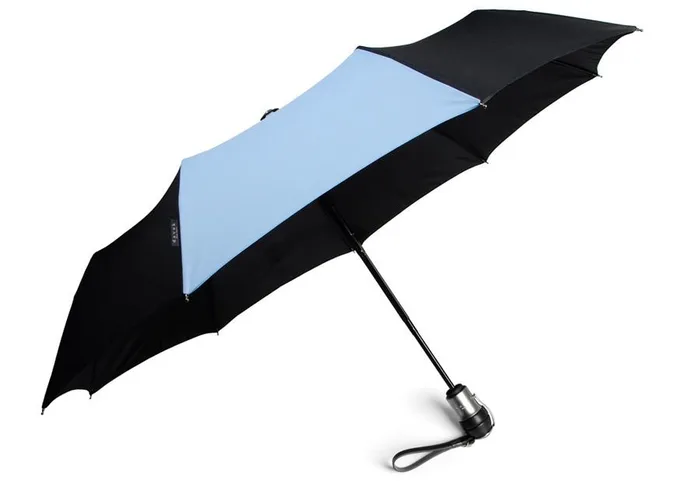
The Davek Solo is the pick: a 9-rib fiberglass reinforced frame, automatic open and close, both canopy measurements published (43 in arc, 37 in straight), and an unconditional lifetime guarantee that repairs or replaces it for any reason, with shipping the buyer's cost. The Weatherman Travel Umbrella is the value buy and the one model here with a stated wind-tunnel figure, 45 mph, plus a 38 in diameter, an 11.8 in closed length and a weight of 0.85 lb. The Blunt Metro depends on your bag: it is built to be repaired and has blunt tips, but it closes to 14.8 in and its page lists auto-open only. Skip the Repel Windproof Travel Umbrella unless you buy it from Repel directly, because the lifetime replacement policy is valid only for direct purchases, the canopy size is not published, and its wind claims have no test attached. None of these replaces a shell in sideways rain. Best for: travelers and commuters who want one umbrella that fits a bag and comes with terms in writing.
Our picks at a glance
- Davek Solo - Buy. A 9-rib automatic compact with both canopy measurements published and an unconditional lifetime guarantee.
- Weatherman Travel Umbrella - Buy. Tied with the Blunt as the lightest here, and the one model in this group with a published wind-tunnel figure.
- Blunt Metro - It depends. A modular, repairable umbrella with blunt canopy tips that is longer when closed than a true travel compact.
- Repel Windproof Travel Umbrella (Standard Series) - Skip. A very popular 9-rib vented compact whose warranty and wind claims are weaker on paper than they sound.
The verdict in 30 seconds
What mattered most
- Published wind figure
- Canopy diameter (straight)
- Canopy arc
- Closed length
- Weight
- Ribs as stated
Every folding umbrella is sold as windproof, and there is no standard behind the word. We read the manufacturers' own pages for four widely sold compact umbrellas to see who publishes a tested wind speed, who gives both canopy measurements, and what the warranty really covers. One of the four states a wind-tunnel figure. The other three use the word, or a number, with no test behind it on the page.
A 9-rib automatic compact with both canopy measurements published and an unconditional lifetime guarantee.
Best for: Frequent travelers and commuters who would rather buy one umbrella and have it repaired than replace a cheap one every year.
- Davek's guarantee covers failure at any time for any reason, with repair or replacement free apart from shipping.
- The spec sheet gives both coverage numbers, 43 in arc and 37 in straight diameter, so you know the real width.
- It opens and closes from the button and closes to 11.75 in with a fiberglass reinforced 9-rib frame.
- At 1 lb 2 oz it is the heaviest umbrella in this comparison.
- Davek calls its RigidFlex frame wind resistant but publishes no wind speed for the Solo.
- The guarantee requires registration unless you bought directly from Davek's own site.
- A vented double canopy is not listed in the specs.
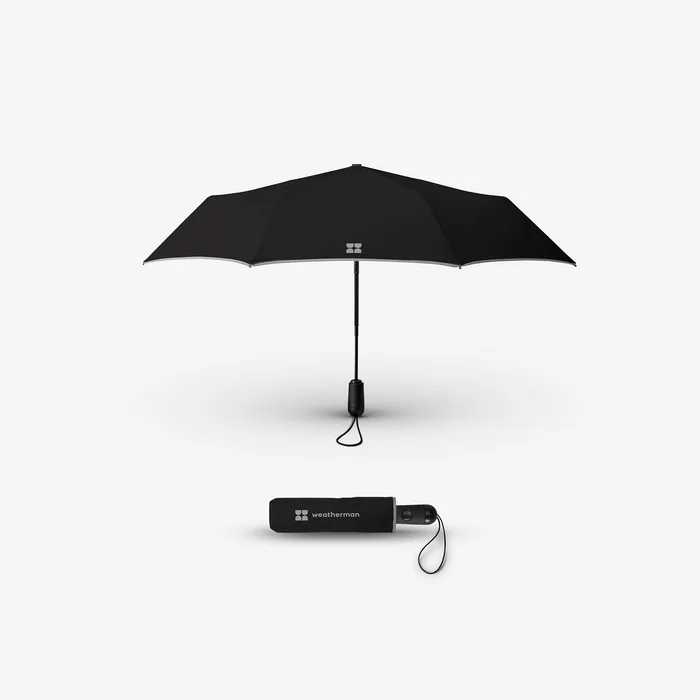
Tied with the Blunt as the lightest here, and the one model in this group with a published wind-tunnel figure.
Best for: Travelers who want a light, automatic umbrella with a stated test figure and do not want to pay premium money.
- Weatherman states the umbrella is wind-tunnel tested up to 45 mph, which is a number you can hold the maker to.
- Both canopy measurements are published: a 38 in open diameter and a 42 in full arc.
- It weighs 0.85 lb, closes to 11.8 in, opens and closes automatically and carries a UPF 50+ rating.
- Rib count and rib material are not published on the product page.
- Weatherman's own size chart places it in its light rain tier, below the larger Trek model.
- The limited lifetime warranty excludes wear and tear and misuse, and purchases from unauthorized third parties are not covered.
- It was listed as a pre-order item when we checked, so delivery may not be immediate.
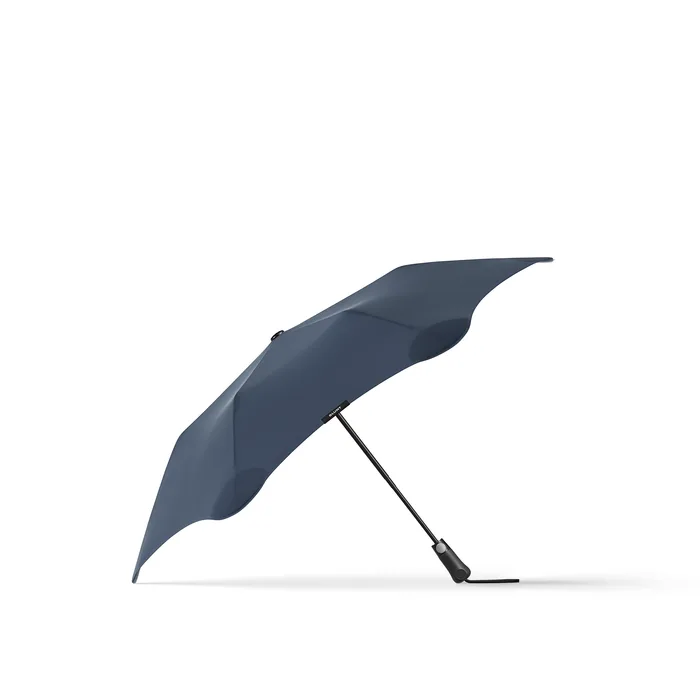
A modular, repairable umbrella with blunt canopy tips that is longer when closed than a true travel compact.
Best for: City walkers with a backpack or tote who care about repairability and crowd-safe tips more than the shortest folded length.
- The canopy, frame, shaft and handle are separate modular parts, and Blunt runs a repair service for them.
- Six patented blunt tips spread tension into the canopy edge and remove the sharp points found on most umbrellas.
- The canopy spins 360 degrees, which Blunt says protects the core mechanism when it gets knocked.
- It closes to 14.8 in, about three inches longer than the other three umbrellas here.
- The product page lists auto-open only, so closing it is a two-handed job.
- Blunt's US product page gives no tested wind speed, only the statement that the canopy withstands all wind conditions.
- The standard warranty is two years and requires registration, with two more years on mechanical parts for account holders.
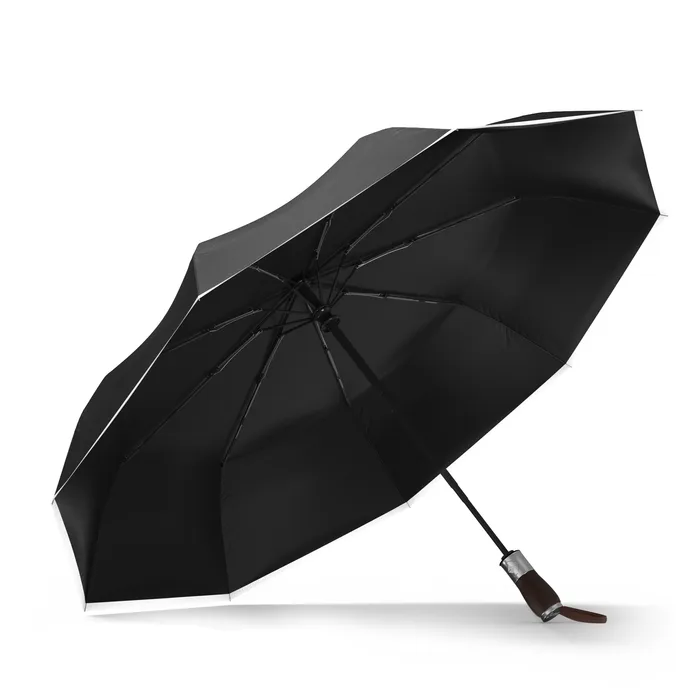
A very popular 9-rib vented compact whose warranty and wind claims are weaker on paper than they sound.
Best for: Buyers ordering straight from Repel's own store who will register it; most others are better served by the Weatherman.
- It has 9 resin-reinforced fiberglass ribs and a double-vented canopy, both stated by Repel.
- It folds to 11.5 in, weighs approximately 15 oz and opens and closes from one button.
- Repel states a Teflon coating on the canopy and includes a travel sleeve.
- Repel's warranty page says the lifetime replacement policy is valid only for items bought directly from Repel and registered.
- The product page claims gusts of 50 mph with no test method, while another Repel listing carries 85 mph in its web address.
- Neither canopy diameter nor arc is published on the product page, so you cannot compare coverage.
- The replacement policy covers defects in materials and workmanship, not damage from use.
| Criteria | Davek Solo Top pick | Weatherman Travel Umbrella | Blunt Metro | Repel Windproof Travel Umbrella (Standard Series) |
|---|---|---|---|---|
| Verdict | Buy it | Buy it | It depends | Skip it |
| Best for | Frequent travelers and commuters who would rather buy one umbrella and have it repaired than replace a cheap one every year. | Travelers who want a light, automatic umbrella with a stated test figure and do not want to pay premium money. | City walkers with a backpack or tote who care about repairability and crowd-safe tips more than the shortest folded length. | Buyers ordering straight from Repel's own store who will register it; most others are better served by the Weatherman. |
| Price tier | $$ · premium | $ · mid-range | $$ · premium | $ · mid-range |
| Published wind figure | None published | 45 mph, wind-tunnel tested | None on US product page | 50 mph claimed, no method |
| Canopy diameter (straight) | 37 in | 38 in | 39.4 in | Not published |
| Canopy arc | 43 in | 42 in | Not published | Not published |
| Closed length | 11.75 in | 11.8 in | 14.8 in | 11.5 in |
| Weight | 1 lb 2 oz | 0.85 lb | 13.6 oz | Approx. 15 oz |
| Ribs as stated | 9, fiberglass reinforced | Not published | Six tips; rib material not stated | 9, resin-reinforced fiberglass |
| Open and close | Auto open and close | Auto open and close | Auto open listed only | Auto open and close |
| Warranty | Unconditional lifetime, repair or replace | Limited lifetime | 2 years, plus 2 on mechanical parts with account | Lifetime replacement, direct purchases only |
Which one is right for you?
- Frequent travelers and commuters who would rather buy one umbrella and have it repaired than replace a cheap one every year. Buy it Davek Solo
- Travelers who want a light, automatic umbrella with a stated test figure and do not want to pay premium money. Buy it Weatherman Travel Umbrella
- City walkers with a backpack or tote who care about repairability and crowd-safe tips more than the shortest folded length. It depends Blunt Metro
- Buyers ordering straight from Repel's own store who will register it; most others are better served by the Weatherman. Skip it Repel Windproof Travel Umbrella (Standard Series)
How we judged the field
Five things separate one compact umbrella from another. First is wind evidence: a stated speed with a test method behind it, since windproof has no standard definition. Second is coverage, which means knowing whether the listed size is the straight diameter or the longer arc. Third is carry size, folded length and weight together. Fourth is the frame as the maker describes it: rib count, rib material, and whether the canopy is vented. Fifth is the warranty wording, including where you have to buy and whether you must register.
The field splits into low-cost compacts sold mainly on a windproof claim and a lifetime promise, and pricier umbrellas sold on engineering and repair. We took the manufacturer’s own page for each model and recorded only what it states. The Davek Solo and Weatherman Travel Umbrella publish the most complete numbers. The Blunt Metro takes a different design route and gives up compactness for it. The Repel is one of the most widely bought compacts, which is why its fine print deserves a close read.
The Davek Solo is the umbrella here with the fewest open questions. Davek lists coverage as 43 in arc and 37 in straight diameter, a closed length of 11.75 in, a weight of 1 lb 2 oz, automatic open and close, and a fiberglass reinforced 9-rib frame. Davek describes the waterproof canopy as its most tightly woven microweave fabric, and the handle has a clip for a belt or bag. What sets it apart is the guarantee: if it fails to function at any time for any reason, Davek repairs or replaces it and you pay shipping. You need to register it unless you bought from Davek’s own site. Each umbrella also carries a loss protection number good for one replacement at up to half off. The trade-offs are weight, since it is the heaviest of the four, and the lack of a published wind speed. Davek calls its RigidFlex frame wind resistant, but gives no wind figure for the Solo. It suits the traveler who wants to buy once and keep it for years.
The Weatherman Travel Umbrella is the model in this group that puts a test figure on its page: wind-tunnel tested up to 45 mph. On the Beaufort scale used by the National Weather Service, that sits at the top of the gale band. Weatherman also publishes both canopy numbers, a 38 in open diameter and a 42 in full arc, along with an 11.8 in closed length and a weight of 0.85 lb, level with the Blunt Metro’s 13.6 oz as the lightest here. It opens and closes automatically, uses a 100 percent recycled fabric rated UPF 50+, and has reflective trim around the edge. The limited lifetime warranty covers damage to the handle, frame or canopy that impairs function, with shipping at your cost, and excludes wear and tear and misuse. What is missing is the frame detail: rib count and material are not published, and no vent is listed. Weatherman’s own chart also files it under light rain, with the larger Trek above it. It suits travelers who want low weight and a stated number at a mid-range cost.
The Blunt Metro is a different kind of umbrella. Instead of pointed rib ends it has six patented blunt tips that Blunt says spread frame tension into the canopy edge, giving a taut canopy without sharp points. The canopy spins 360 degrees so knocks in a crowd do not strain the mechanism. Blunt builds it from four modular parts, canopy, frame, shaft and handle, and offers repairs, with a small charge once the warranty has ended. The published specs are a 39.4 in open diameter, a 14.8 in closed length and a weight of 13.6 oz. That closed length is the catch for travel: it is about three inches longer than the others, and Blunt itself points it at handbags, totes, backpacks and briefcases. The page lists auto-open only. Blunt’s US product page states no wind speed, and its warranty is two years with registration, plus two more on mechanical parts for account holders. It suits city walkers who value a repairable build over the smallest fold.
The Repel Windproof Travel Umbrella is one of the most commonly bought compacts, and the hardware Repel describes is reasonable: 9 resin-reinforced fiberglass ribs, a double-vented canopy, automatic open and close, an 11.5 in folded length and a weight of approximately 15 oz. The problems are in what stands behind it. Repel’s warranty page says the lifetime replacement policy is valid only for items purchased directly from Repel and registered, and that it covers defects in materials and workmanship. Many buyers pick this umbrella up elsewhere and assume the lifetime promise came with it. The wind claim is also loose: the product page says it withstands gusts of 50 mph with no test described, while another Repel compact listing carries 85 mph in its web address. Canopy diameter and arc are not on the product page at all. At a similar tier the Weatherman gives a tested figure and both measurements. The Repel makes sense only for someone buying direct from Repel and registering it.
Davek Solo vs Weatherman Travel Umbrella: which should you buy?
The Davek Solo and Weatherman Travel Umbrella are close on size. Both are automatic, both close to just under 12 in, and their canopies are within an inch of each other at 37 in and 38 in straight diameter. The differences are weight, frame disclosure and terms. The Weatherman is 0.85 lb against the Davek’s 1 lb 2 oz. Davek states a fiberglass reinforced 9-rib frame; Weatherman does not publish its rib count. Weatherman publishes a 45 mph wind-tunnel figure; Davek publishes none for the Solo.
Choose on how you treat umbrellas. If yours tend to die from accidents, such as car doors, crushed bags and rough handling, Davek’s any-reason guarantee is the stronger cover, since Weatherman’s warranty excludes misuse. If you want the lightest carry, a number for wind, and a lower outlay, take the Weatherman. Either way, register the umbrella if you bought it anywhere other than the maker’s own site.
What to look for
- Wind evidence: look for a stated speed and a named method such as a wind tunnel, because windproof alone has no standard meaning.
- Diameter and arc: check which one the listing quotes, since arc is measured over the curve and runs several inches larger than the straight width.
- Closed length and weight: compare both against your actual bag, as an umbrella near 12 in fits most side pockets while one near 15 in may not.
- Ribs as stated: note the rib count and material the maker publishes, and treat a missing figure as unknown instead of assuming it.
- Open and close: confirm the page says automatic close as well as automatic open if you want one-handed use.
- Warranty wording: read what is covered, whether registration is required, and whether it applies when you buy from a third-party seller.
Our final take
The Davek Solo is the compact umbrella to buy if you want complete published specs and a guarantee that covers any failure, and you accept the extra weight and premium cost. The Weatherman Travel Umbrella is the better value, tied for the lightest of the four, and the one with a wind-tunnel figure on its page. The Blunt Metro is worth it for people who prize a repairable, blunt-tipped design and carry a bag long enough for it. The Repel is fine hardware with terms that do not follow it to most checkouts, so we would pass unless buying direct. Whatever you choose, an umbrella is for rain that falls down; pair it with a shell for the days it blows sideways.
Questions, answered
What does windproof mean on an umbrella?
Nothing fixed. There is no standard test that an umbrella has to pass to be called windproof, so each maker defines it for itself. Of the four models here, Weatherman states a wind-tunnel figure of 45 mph for its Travel Umbrella. Repel states 50 mph on its product page without describing a test, and Davek and Blunt describe wind testing or wind-resistant design without publishing a speed for these models. Treat a number with a named test method as evidence and a bare adjective as advertising.
What is the difference between canopy arc and canopy diameter?
Diameter is the straight line across the open canopy from edge to edge, which is the width of dry space underneath. Arc is measured over the top of the canopy along its curve, so it is the larger number for the same umbrella. Davek lists the Solo at 43 in arc and 37 in straight diameter, and Weatherman lists 42 in full arc and 38 in open diameter. A listing that gives one unlabelled number is often quoting arc, which makes the umbrella sound bigger than the space it covers.
How small should a travel umbrella fold?
Three of the four umbrellas here close to between 11.5 and 11.8 in, short enough for many daypack side pockets. The Blunt Metro closes to 14.8 in, which Blunt says suits a handbag, tote, backpack or briefcase. Weight matters as much as length if you carry it daily: the range here runs from 0.85 lb to 1 lb 2 oz. Check both numbers against the bag you actually use.
Is a lifetime warranty on an umbrella worth anything?
It depends on the wording. Davek's guarantee covers failure at any time for any reason, with the buyer paying shipping. Weatherman's limited lifetime warranty covers damage to the handle, frame or canopy that impairs function, but excludes wear and tear and misuse. Repel's lifetime replacement policy covers defects in materials and workmanship and, per its warranty page, applies only to items bought directly from Repel and registered. Read where you must buy and whether you must register before the word lifetime sways you.
Should I pack an umbrella or a rain jacket for a trip?
For city walking in steady rain with little wind, an umbrella keeps your top half and your bag dry and lets you skip a hood. In gusty or sideways rain a jacket does the work and an umbrella becomes a liability, whatever the listing says. Many travelers carry both, since a compact under a pound adds little to a bag. Our rain jacket comparison covers the shell side of that choice, and our carry-on luggage comparison covers the bag it has to fit.
Deciding between the top two? See our head-to-head: Davek Solo vs Weatherman Travel Umbrella.
More Outdoors & Fitness reviews
 The Best Trekking Poles: 4 Compared (and One to Skip)
  The Best UV Protective Shirts: 4 Compared (and One to Skip)
  The Best Via Ferrata Sets: 4 Compared (and One to Skip)
  The Best Wheelbarrows & Garden Carts: 4 Compared (and One to Skip)
  The Best Women's Winter Parkas: 4 Compared (and One to Skip)
  The Best Winter Running Tights: 4 Compared (and One to Skip)